
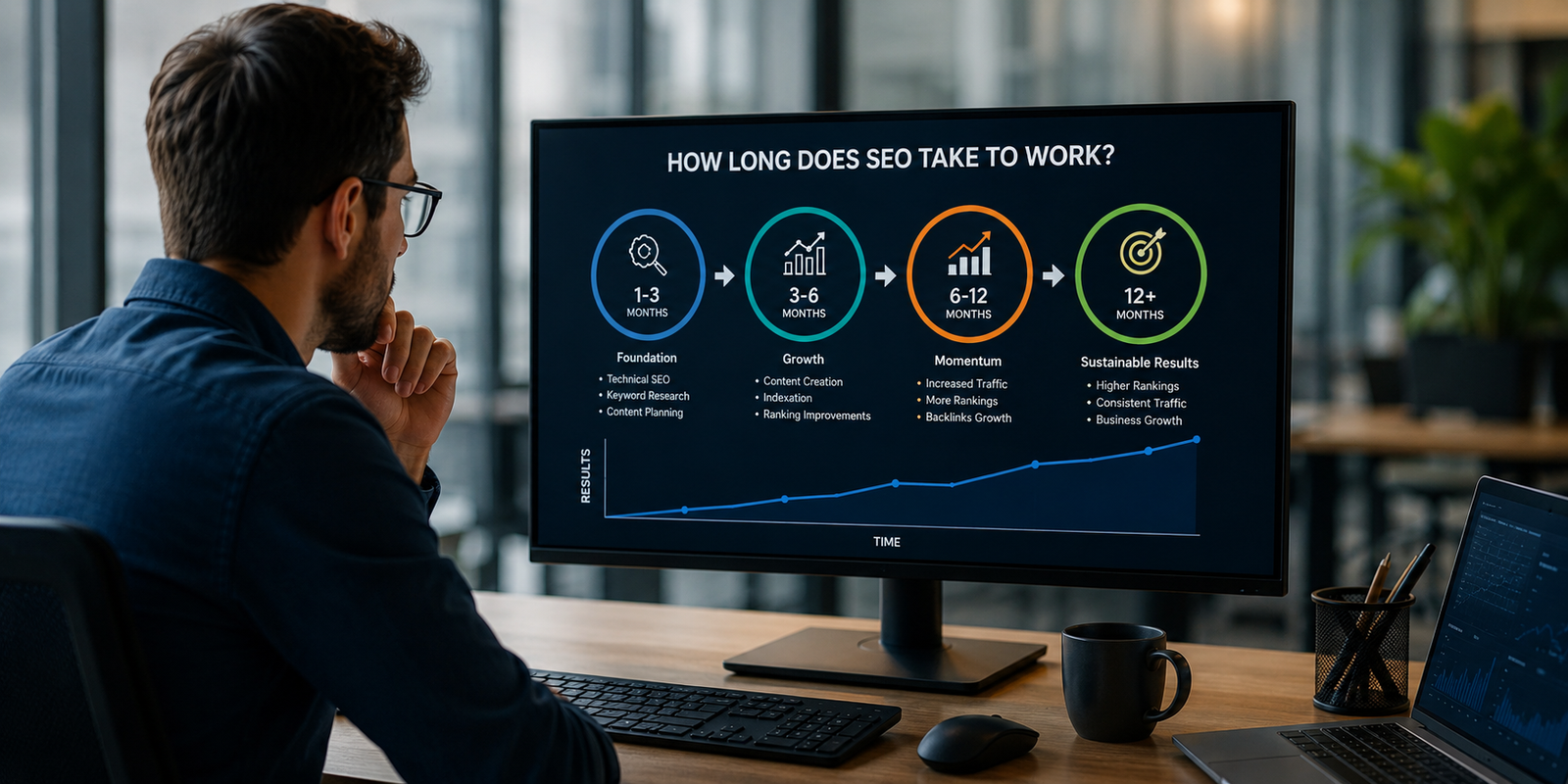
Every business owner investing in search engine optimization asks the exact same fundamental question how long does SEO take to work when launching a new campaign? You want to know when your financial investment will convert into tangible search engine visibility, steady organic traffic, and predictable business revenue.
The realistic direct answer is that search engine optimization typically takes between 4 to 6 months to start showing noticeable results, while major business outcomes like significant revenue growth and dominant industry keyword rankings usually require 6 to 12 months of consistent execution.
Determining how long does SEO take to work requires looking beyond quick vanity metrics and focusing on true digital growth, as search algorithms prioritize established authority, technical reliability, and helpful content over instant tricks. However, if you are looking for a sustainable digital asset that drives high quality leads and sales, it is one of the most valuable investments you can make.
The timeline depends heavily on the current state of your website, the level of competition in your industry, and the quality of the execution. Professional SEO Agency can help develop and implement a strategic approach based on these factors. Search engines like Google rely on complex algorithms to determine which pages deserve the top spots. Unlike paid advertising, which stops the moment you stop paying, SEO continues to work for you long after the initial optimization is complete.
Key Takeaways Summary
- Direct Answer Timeline: Initial improvements in impressions appear within 1 to 3 months, traffic growth occurs in 3 to 6 months, and significant lead generation takes 6 to 12 months.
- Core Influencing Factors: Your timeline depends heavily on domain age, current website authority, technical health, content quality, and niche keyword competition.
- New vs. Existing Sites: Brand new domain names face a sandbox effect that stretches timelines, whereas established websites with strong technical foundations see faster wins.
- Compound Growth Value: Search engine optimization builds cumulative momentum; results compound over time rather than vanishing when you pause ad spending.
How Long Does SEO Usually Take?
For most medium size businesses, search engine optimization yields measurable outcomes between month 4 and month 6. During this period, search engines crawl updated technical structures, index revised keyword rich copy, and evaluate new inbound authority links.
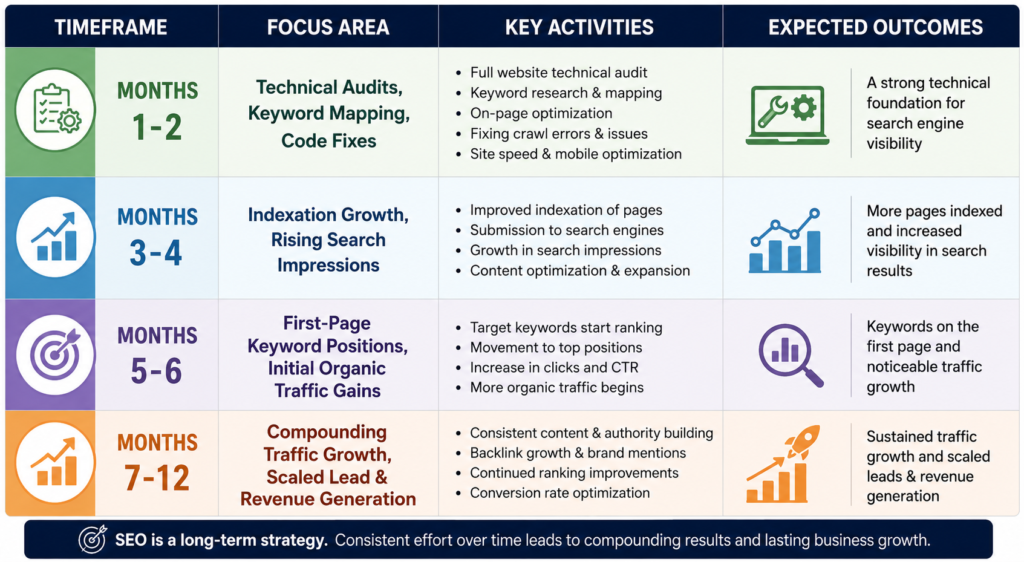
Industry studies and agency data consistently show that SEO takes time to gain traction. According to a study by Ahrefs, only about 5.7% of newly published pages rank in the Google Top 10 within one year. The vast majority of pages that reach the first page are at least two to three years old.
However, that statistic applies to all pages on the internet, including low quality ones. For a professional website with a dedicated SEO strategy, the timeline is more accelerated. For a new website without existing domain authority, you are usually looking at six to twelve months to see significant traction. For an established website that simply needs optimization, you might see movement in three to six months.
What Does It Mean for SEO to Work?
To understand the timeline, you must define success correctly. SEO is not a single event; it is a funnel. “Working” means different things at different stages of the funnel.
- Indexing: Search engines have found your page and stored it in their database.
- Ranking: Your page appears on search engine results pages for relevant queries.
- Visibility: Your page appears high enough (usually page one) to be seen by users.
- Traffic: Users click on your listing and visit your website.
- Conversion: The user takes a desired action, such as making a purchase or filling out a form.
When a client asks why their SEO is not working, often the rankings are improving, but the traffic hasn’t followed yet. Or perhaps the traffic is growing, but the leads haven’t materialized. A successful campaign must move through these stages systematically. You cannot skip from ranking to sales without passing through traffic.
When Do SEO Rankings Start Improving?
Keyword ranking improvements are often the first tangible sign that your SEO strategy is correct. You can expect to see movement in the search engine results pages within the first four to twelve weeks of a campaign. This usually starts with long tail keywords—phrases that are longer and more specific best seo services for dentists in Austin—rather than broad, high competition terms like “SEO services.”
Google tests the waters by ranking your page for lower competition terms first. If users interact positively with your content (high click through rates, long time on page, low bounce rates), Google will gradually trust you with more competitive keywords. Monitoring these initial ranking shifts is crucial because it indicates that your technical fixes and content updates are being recognized by the algorithm.
When Does Organic Traffic Start Increasing?
Organic traffic lags behind rankings. Once your pages consistently rank in the top 10 for keywords that actually get searched, traffic begins to flow. Typically, you will see a noticeable uptick in organic traffic between months three and six. This is the phase where the “compound effect” starts to kick in.
Rather than a straight line, traffic grows in a step like pattern. You will see a spike when a specific page hits page one, followed by a plateau as Google evaluates user behavior. Then, as you add more content and earn more backlinks, another spike occurs. By month six, you should have enough data in Google Analytics and Google Search Console to identify which pages are driving the most users and which ones need further optimization.
When Do Leads and Sales Begin to Grow?
Leads and sales are the final phase of the SEO timeline. This stage depends not only on your rankings but also on your website’s conversion rate optimization. It is entirely possible to have high traffic but low sales if your landing page has a weak call to action or a confusing layout.
Assuming your website is optimized for conversions, you can expect to see a steady increase in leads and sales starting around months four to six, with significant growth occurring after month six. By this time, your website has accumulated enough topical authority that users trust you. Additionally, the traffic you receive is highly targeted—these are people actively searching for the products or services you offer, making them much easier to convert than cold traffic from social media.
Why Does SEO Take So Long?
How Google Finds and Ranks Your Pages
Google uses automated bots called crawlers to discover pages. Once a page is crawled, it is rendered and indexed. Only after indexing can a page rank. However, Google indexes trillions of pages, and it must sort them using over 200 ranking signals. This sorting process, known as the algorithm, requires time to validate that your content is not spam and that it genuinely satisfies user intent.
Why New Websites Often Take Longer
New websites suffer from what is often called the “Google Sandbox” effect. While Google denies a specific sandbox filter, the effect is real: new domains have zero trust. They have no backlink profile and no history of publishing good content. Google applies a “wait and see” period to new domains to ensure they are not spam websites that will disappear in a week. This validation period is why starting a blog on a new domain takes longer than publishing a post on an established site like Medium or LinkedIn.
How Competition Changes the Timeline
If you are in a highly lucrative industry, such as insurance, law, or real estate, you are competing against websites that have spent millions of dollars on SEO over the past decade. Outranking them takes time and significant resources. Conversely, if you are in a niche market with little competition, you can rank on the first page within weeks simply by publishing a well structured page.
Why Website Authority Matters
Authority, measured by metrics like Domain Rating or Domain Authority, is a proxy for trust. It is primarily built through backlinks from other reputable websites. Earning these links requires outreach, digital PR, and publishing content that is so good people naturally want to reference it. This is the slowest part of SEO. You cannot rush trust; you must earn it through consistent excellence.
SEO Timeline What to Expect Month by Month
Understanding the monthly progression helps manage expectations and prevents discouragement.
What Happens During the First Month?
The first month is all about discovery and foundation.
- Technical Audit: Identifying crawl errors, site speed issues, and mobile usability problems.
- Keyword Research: Mapping out the terms your customers are using.
- On-Page Setup: Fixing title tags, meta descriptions, and internal linking structures.
- Baseline Data: Recording your current positions, traffic, and conversions to measure future growth.
What Changes in Months 2–3?
This is the implementation phase.
- Content Creation: Publishing high quality pages targeting your primary keywords.
- Technical Fixes: Resolving the issues found in the audit.
- Ranking Fluctuations: You may see your rankings jump around as Google evaluates your changes. This is a positive sign that Google is paying attention.
- First Signs of Life: Early rankings for long tail keywords appear.
What Can You Expect in Months 4–6?
This is where momentum begins.
- Settled Rankings: The “dance” stops, and your pages settle into stable positions.
- Traffic Growth: Organic sessions begin to increase steadily.
- Backlink Acquisition: Outreach campaigns start to yield results, boosting authority.
- Lead Generation: If your funnel is correct, you should start receiving inquiries regularly.
What Happens After 6 Months?
After six months, you enter the optimization and scaling phase.
- Data-Driven Tweaks: You analyze which content is ranking on page two (position 11-20) and update it to push it to page one.
- Authority Building: You now have enough data to pursue high authority backlinks aggressively.
- Compounding Returns: The results of your previous months of work begin to amplify each other. By month 12, you often see exponential growth compared to month 6.
What Factors Affect How Fast SEO Works?
| Factor | Impact on Speed | Explanation |
|---|---|---|
| Website Age and Existing Authority | High | Older domains with strong backlinks rank faster than new domains with zero trust. |
| Keyword Competition | High | High volume, commercial keywords take longer due to established competitors. |
| Content Quality and Relevance | Medium | Great content that matches search intent ranks faster than thin content. |
| Technical SEO and Performance | Medium | Slow, broken, or poorly indexed sites hinder crawling and ranking. |
| Backlinks and Website Trust | High | Sites with high-quality referring domains gain trust faster. |
| Consistency of SEO Work | High | Regular publishing and optimization signal to Google that the site is active. |
How Long Does It Take to Rank on Google?
To rank on Google at all (even on page 5), it takes between one to three months for Google to index your page and determine its relevance. To rank in the top 10 results, the timeline is four to six months for low competition keywords and twelve to eighteen months for high competition keywords.
How Long Does It Take to Reach the First Page?
Reaching the first page is the primary goal for most businesses. Based on an analysis of millions of websites, the average Top 10 ranking page is usually over two years old. However, those sites may not have been actively optimizing. With active optimization and a strong backlink profile, reaching the first page in six months is a reasonable expectation for a moderately competitive niche.
Can a New Website Rank Quickly?
Yes, but only for specific queries. A new website can rank quickly if it targets “zero volume” or very specific long tail keywords, such as “how to fix a leaky faucet in a 2015 Kohler model.” These queries have low competition. For commercial terms like “plumber,” a new site has almost no chance of ranking quickly against established local businesses.
Why Some Keywords Take Longer to Rank
Keywords with high commercial intent (meaning the searcher wants to buy something) attract the most aggressive SEO competition. Businesses are willing to spend significant money to rank for these terms because they drive revenue. Google holds these “Your Money or Your Life” (YMYL) niches to higher standards, requiring stronger evidence of expertise, authoritativeness, and trustworthiness (E-A-T). This strict vetting process inevitably extends the timeline.
How Can You Tell If Your SEO Is Working?
Early Signs Your SEO Is Improving
Before sales roll in, you can look at “leading indicators” in Google Search Console.
- Indexation: The number of pages indexed by Google is increasing.
- Impressions: Your site is appearing in search results for more queries, even if users aren’t clicking yet.
Growing Search Impressions and Clicks
Impressions are the first step. If your impressions are trending upward, Google is testing your pages for relevance. Clicks follow when your average position improves to the top 5 or top 3 results, as the majority of users click on the first three results.
Improving Keyword Rankings
Using rank tracking tools, you should see your target keywords moving from position 50 to position 20, then to position 10. This is a lagging indicator but a clear sign of health.
Increasing Organic Traffic
This is the KPI most businesses care about. A steady quarter over quarter increase in organic sessions indicates that your SEO is working and compounding.
Getting More Leads and Conversions
The ultimate proof of ROI. Ensure you have conversion tracking set up in Google Analytics 4 (GA4) to attribute leads back to the specific organic landing pages that generated them.
Can You Make SEO Results Happen Faster?
While you cannot cheat the algorithm, you can accelerate your timeline by being aggressive with your strategy.
Step by Step Guide to Accelerating SEO
- Fix Technical SEO Problems: If Google cannot crawl your site efficiently, nothing else matters. Fix broken links (404s), reduce server response time, and ensure your site is mobile-first indexed.
- Focus on Realistic Keywords: Stop chasing “best CRM software.” Instead, go after “best CRM software for solo real estate agents.” Lower competition means faster wins.
- Publish Helpful Content: Create content that answers the question better than anyone else. Include original data, videos, and images. Do not just rehash what the top 10 results already say.
- Improve Existing Pages: Identify pages sitting in positions 8 to 15. Refresh them with new information, better internal links, and updated statistics. This is often faster than writing a new page.
- Earn Relevant Backlinks: Use digital PR, guest posting on industry blogs, and creating linkable assets (like free tools or original research) to earn links quickly.
What Can Slow Down SEO Results?
- Targeting Very Competitive Keywords: If you are a startup trying to rank for “insurance,” you are wasting time. Scale down your ambitions initially.
- Publishing Weak or Unhelpful Content: Content written by AI without human editing, or content that lacks expertise, will not rank. Google’s Helpful Content Update actively demotes content written for search engines rather than people.
- Ignoring Technical Issues: A page stuck in “Crawled but not indexed” status is a technical failure.
- Making SEO Changes Too Infrequently: SEO is a muscle. If you only work on it once a quarter, you will lose ground to competitors who publish weekly.
- Using Risky or Spammy SEO Tactics: Buying backlinks or using Private Blog Networks (PBNs) can result in a manual action from Google, which drops your traffic to zero overnight.
Can SEO Really Work in 30 Days?
In 30 days, SEO can work in the sense that you can lay the groundwork. You can fix critical technical errors that were blocking your site, and you can publish high quality content. However, you will rarely see a significant increase in leads within 30 days unless you are in a completely uncontested niche. If an agency promises you “Page 1 in 30 days,” they are likely using black hat tactics that will eventually harm your site. As a rule of thumb, the first 30 days are about planning and setup, not results.
How Long Should You Give SEO Before Judging Results?
You should commit to a minimum of six months of consistent SEO work before making a judgment call on its success. This does not mean you ignore the data for six months; you should review analytics weekly. However, you should not decide to “cancel SEO” because you are not number one after three months.
At the six month mark, assess the trajectory. Are you seeing more impressions? Has organic traffic increased by any percentage? Are you ranking for some secondary keywords? If the answer is yes, the strategy is working and needs more time to mature. If the answer is no to all three, it is time to audit the strategy itself.
Is SEO Worth the Time and Investment?
Yes, absolutely. While the initial waiting period is difficult, SEO offers the highest Return on Investment (ROI) of any digital marketing channel in the long run. Unlike paid ads where the cost per click is rising annually, organic traffic is free. Once you secure a top spot, you do not pay for every click. Furthermore, users trust organic results more than ads.
Comparison Table: SEO vs. PPC Timeline
| Feature | SEO | PPC (Pay-Per-Click) |
|---|---|---|
| Time to First Result | 3 to 6 months | Immediately |
| Cost Over Time | Decreases (cost per lead drops as rankings solidify) | Increases (bid prices rise with competition) |
| Sustainability | High (traffic remains if you stop paying temporarily) | Zero (traffic stops the moment you stop paying) |
| Trust Factor | High (users trust organic listings) | Lower (users know it is an advertisement) |
Checklist Section
Use this checklist to ensure you are on track during your SEO journey:
- Month 1
- □ Google Analytics and Search Console installed.
- □ Technical audit completed.
- □ Keyword list mapped to specific pages.
- Month 2-3
- □ First batch of optimized content published.
- □ Technical errors resolved.
- □ Social profiles and citations set up for branding.
- Month 4-6
- □ First backlink building campaign executed.
- □ Old content updated based on new data.
- □ Conversion rate optimization review.
- Month 6+
- □ Analyze high performing content.
- □ Scale up content production.
- □ Pursue high authority digital PR links.
Frequently Asked Questions About SEO Results
Can SEO Work in One Month?
SEO can start working in one month by fixing technical errors and indexing issues, but the business results (leads and sales) will not be visible that quickly. You are setting the table.
Why Is My Website Not Ranking After Three Months?
Three months is still very early. You may be targeting keywords that are too competitive, or your website authority is too low. Check Google Search Console to ensure your pages are being crawled and indexed correctly.
How Long Does a New Website Take to Rank?
A brand new domain usually takes six to twelve months to rank for competitive commercial keywords. It needs to pass the trust threshold with Google first.
How Long Does It Take to Get SEO Traffic?
You should start seeing organic traffic from long tail keywords within 90 days. Substantial traffic from high volume keywords usually takes six to nine months.
Do SEO Results Keep Improving Over Time?
Yes, if you continue to update the site. SEO compounds. Older pages that have built authority help new pages rank faster, creating a snowball effect that accelerates growth in year two and three.
Final Thoughts
The honest answer is that it takes about six months to see a return on your investment and up to a year to see the full potential of your strategy. It requires patience, but it is the only digital marketing strategy that builds compounding equity for your business.
If you are ready to stop guessing and start growing, you need a team that understands the mechanics of modern search. At, we specialize in building long term organic growth engines that drive sustainable revenue. Contact us today for a comprehensive audit and a realistic roadmap to the top of the search results.